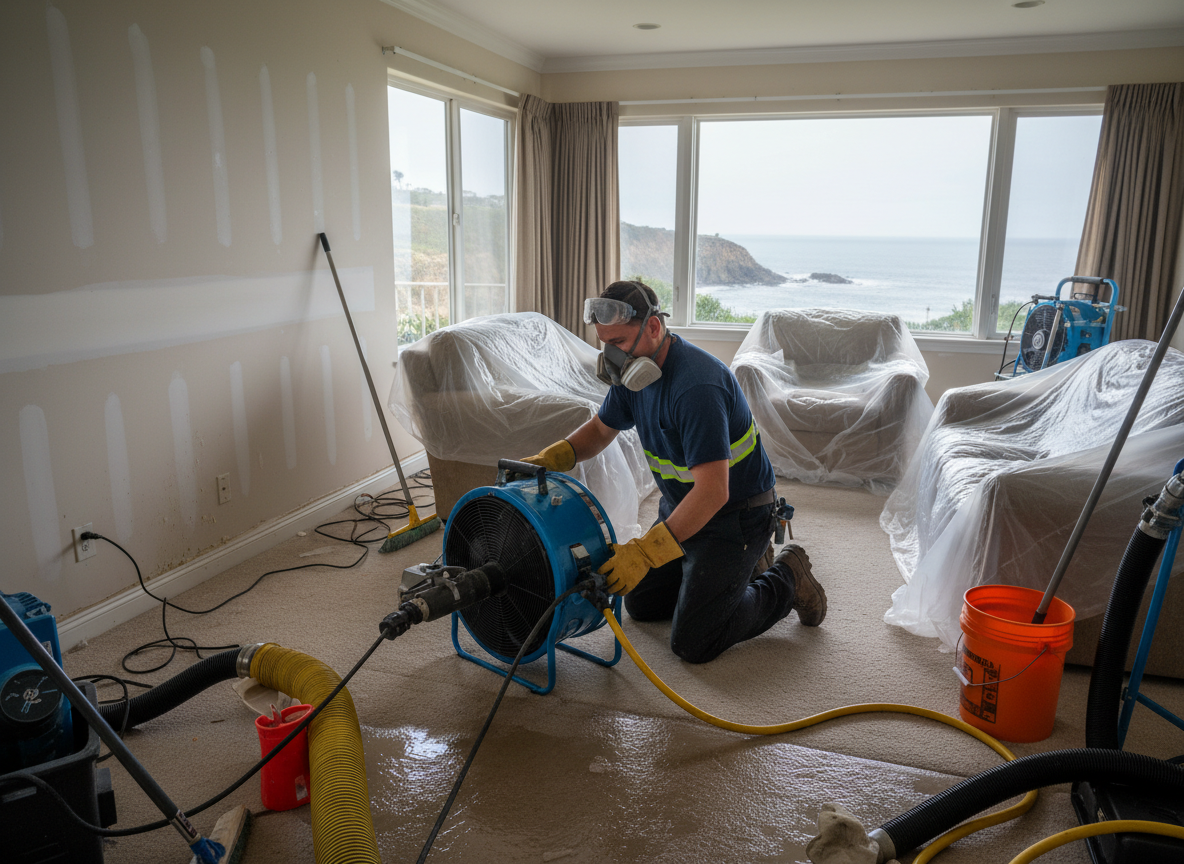
Rancho Palos Verdes sits in Los Angeles County with a mild Mediterranean climate shaped by constant Pacific breezes. These conditions keep temperatures moderate yet push humid air into homes along the Rolling Hills Estates border and in Portuguese Bend. Older single-story ranch houses and mid-century builds common here often have crawl spaces and slab foundations that trap moisture when ocean fog rolls in from Terranea Resort and Point Vicente Lighthouse. Mitigation starts with rapid moisture mapping to locate water that has wicked into stucco or under tile before it reaches framing.
Hillside lots near Los Verdes Golf Course and Seaview frequently experience runoff after winter rains that the ocean-moderated weather does not fully dry. Water migrates along retaining walls and enters garages or lower-level rooms through expansion joints. Technicians must account for the clay-heavy soils that hold moisture longer than inland Los Angeles County sites, requiring extended drying times and targeted extraction along the foundation perimeter to prevent recurrence in neighboring Palos Verdes Estates and Rolling Hills.
San Pedro-adjacent properties can see tidal-influenced groundwater pressure during king tides that pushes through older plumbing penetrations. Mitigation crews isolate affected zones, remove saturated baseboards, and apply negative air to keep spores from drifting into unaffected living areas. Because many homes here lack modern vapor barriers, every job includes checking subfloor sheathing and rim joists that standard drying protocols miss in flatter inland neighborhoods.
Technician insight
In Rancho Palos Verdes, the thing that catches most people out with water damage mitigation is how Pacific breezes push marine layer moisture deep into crawl spaces of older hillside homes near Abalone Cove Shoreline Park, where standard fans alone never reach the rim joists before hidden rot starts.
Seepage After Marine Layer in Seaview
A Seaview residence near Terranea Resort showed recurring dampness along the garage slab. Inspection revealed water tracking from the slope through unsealed penetrations. Extraction and targeted drying along the foundation stopped the intrusion before it reached living areas.
How it works
- 1
Emergency Assessment
Arrive on site within hours to document water source and map moisture levels across Portuguese Bend and Seaview properties.
- 2
Water Extraction
Remove standing water and pull moisture from carpets, padding, and hardwood using truck-mounted equipment suited to hillside access.
- 3
Drying and Dehumidification
Position air movers and dehumidifiers calibrated for ocean-influenced humidity while monitoring daily readings.
- 4
Antimicrobial Application and Clearance
Treat affected materials and verify dryness before returning the structure to the homeowner.
Pricing
Cost depends on water volume, affected square footage, and access constraints on sloped lots; upfront assessment provided before work begins.