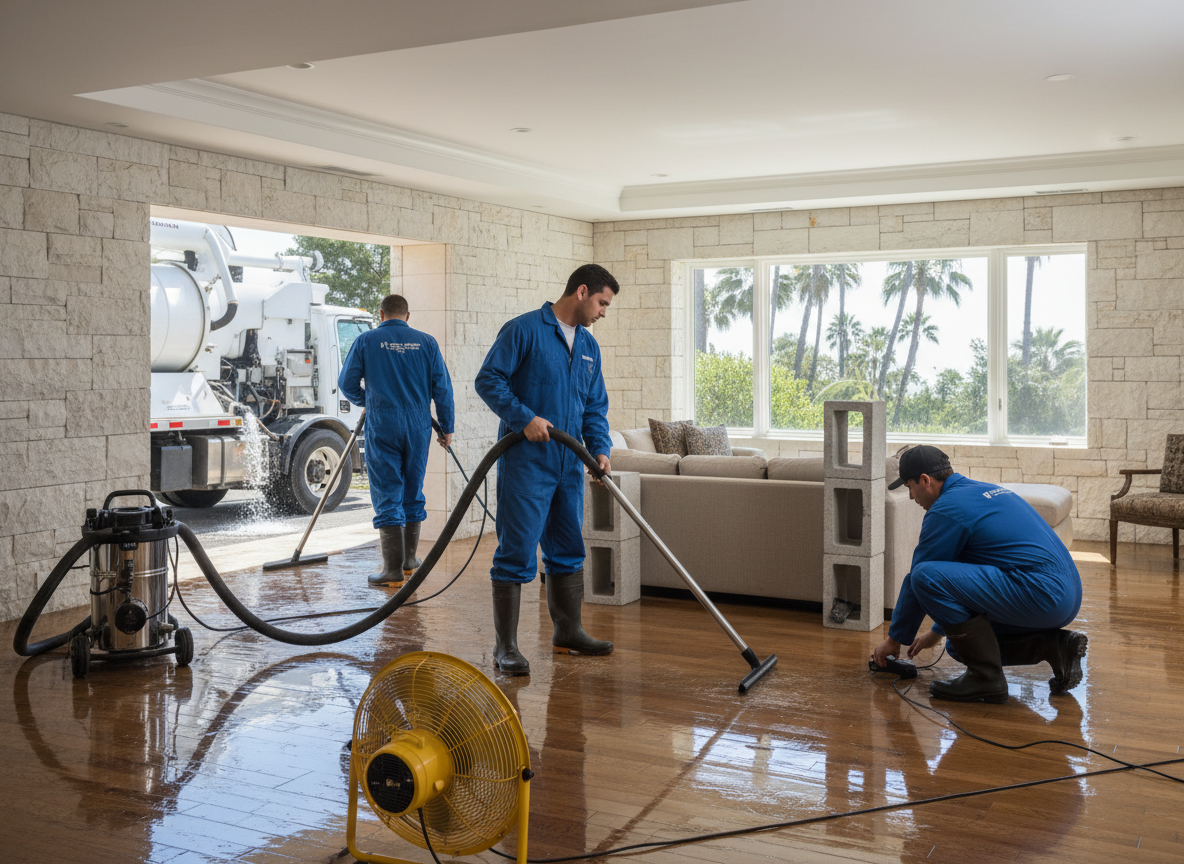
Rancho Palos Verdes sits on hilly coastal terrain where Pacific Ocean breezes create a mild Mediterranean climate that slows natural evaporation. Water from roof leaks or pipe bursts often migrates under stucco-clad homes built in the 1960s and 1970s, especially near Portuguese Bend and the Rolling Hills Estates border. Extraction crews must account for clay soils that hold moisture against foundations and the risk of hidden saturation in crawl spaces common to Seaview and Abalone Cove Shoreline Park properties.
Emergency water removal here differs from inland jobs because salt-laden air accelerates corrosion on metal subfloor components once water is present. Technicians use moisture meters calibrated for Los Angeles County coastal humidity levels and deploy air movers in patterns that follow the prevailing breeze direction to avoid pushing damp air deeper into wall cavities. Homes near Terranea Resort and Los Verdes Golf Course frequently see water travel along sloped lots, requiring perimeter channeling before interior drying begins.
Older plumbing in Palos Verdes Estates and San Pedro border homes can fail under pressure changes after heavy winter rains, sending water into finished basements. Rapid removal prevents secondary damage to hardwood floors and electrical systems that sit close to grade in many mid-century ranch layouts. Crews document saturation depths room by room because insurance adjusters in this county require precise moisture mapping before approving extended drying equipment.
Technician insight
In Rancho Palos Verdes, the thing that catches most people out with Emergency water removal is how clay soils around Portuguese Bend trap water under slabs for weeks after the initial extraction, especially when Pacific breezes keep surface humidity high and mask the problem.
Hillside Home Near Point Vicente Lighthouse
Winter rain overwhelmed drainage on a sloped lot near the lighthouse. Water entered the crawl space of a 1970s stucco home. Extraction focused on channeling flow away from the foundation before targeted drying equipment was placed. The structure dried without mold growth or floor damage.
How it works
- 1
On-Site Assessment
Technicians arrive within hours, map water migration through the home's hillside layout, and identify hidden pockets created by ocean breezes and clay soil.
- 2
Water Extraction
High-volume pumps and wands remove standing water from slabs, crawl spaces, and sloped lots before it migrates toward Portuguese Bend or Terranea properties.
- 3
Targeted Drying
Air movers and dehumidifiers are positioned to work with Pacific breezes, focusing on older stucco walls and subfloors common in Rancho Palos Verdes.
- 4
Moisture Verification
Final readings confirm dryness across Los Angeles County coastal materials, preventing long-term issues in neighborhoods like Seaview and Abalone Cove.
Pricing
Upfront quotes after inspection; costs depend on water volume, home slope, and drying duration.